
Sandbox
This page brings together frequently asked questions about the Asaas Sandbox environment, focusing on account creation, fictitious balance, features available for testing, and Pix QR Code payment.
Sandbox is a test environment separate from the Production environment. It allows you to validate integration flows without moving real amounts, offering greater security before going into production.
When to use this FAQ
Use this page when you need to clarify questions about:
- Sandbox account creation;
- adding fictitious balance;
- payment simulation;
- Pix QR Code payment testing;
- features available in the test environment;
- Sandbox limitations;
- differences between Sandbox and Production;
- homologation best practices.
1. How do I create my Sandbox account?
Sandbox is a test environment where you can receive fictitious charges and test integrations and Webhooks before using the Production environment.
You can create your Sandbox account at:
ImportantSandbox and Production are independent environments.
Customers, charges, API Keys, Webhooks, balance, and settings created in Sandbox are not shared with the Production environment.
2. Which features can I test in my Sandbox account?
In the Sandbox environment, you can test several integration flows, such as:
- creating and updating customers;
- creating charges;
- charges by bank slip;
- charges by Pix;
- charges by credit card;
- installment charges;
- payment split;
- transfers;
- transactions;
- Webhooks;
- resource consultation and update flows.
To consult the complete and updated list of features available for testing, access the What can be tested documentation.
RecommendationBefore starting the homologation of your integration, consult the What can be tested page to confirm whether the desired resource is supported in Sandbox.
3. How can I add balance to my Sandbox account?
In Sandbox, it is possible to add fictitious balance to the account to perform tests.
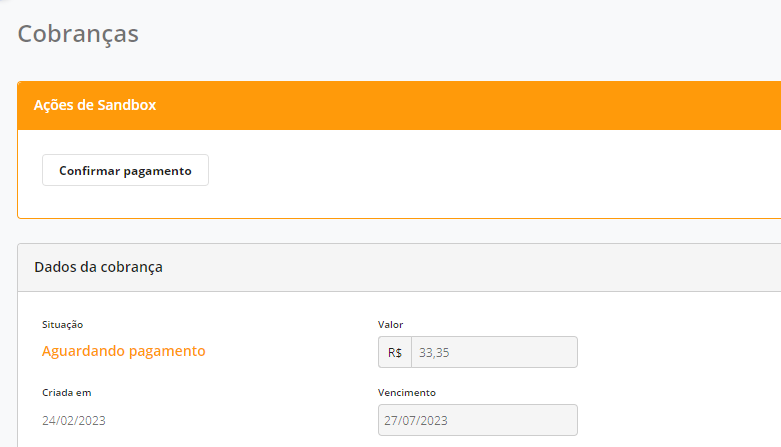
A common way to do this is to create fictitious customers and fictitious charges. After creating a charge with payment via Bank Slip or Pix, a CONFIRM PAYMENT button will be displayed, allowing you to simulate receiving that charge.
If the charge is by Credit Card and has the status CONFIRMED, the RECEIVE PAYMENT button will be displayed.
Recommended flow:
Create fictitious customer
↓
Create fictitious charge
↓
Access the charge in Sandbox
↓
Confirm or receive the payment through the interface
↓
Validate the fictitious balance
↓
Test the desired flow
ImportantCurrently, there is no specific endpoint to confirm payment via API in Sandbox.
Confirmation must be performed through the Sandbox environment interface.
4. Is it possible to confirm payment via API in Sandbox?
No.
At the moment, there is no specific endpoint for payment confirmation via API in Sandbox.
To simulate receiving charges, use the buttons available in the Sandbox interface, such as CONFIRM PAYMENT or RECEIVE PAYMENT, according to the type and status of the charge.
BaaS subaccountsTests in BaaS subaccounts that depend on payment confirmation must be handled directly with the Integration Success team.
5. How to test the Pix QR Code payment functionality in Sandbox?
To test Pix QR Code payment in Sandbox, first create a static Pix QR Code in your Asaas account.
You can use the Create static QR Code reference:
When creating the static QR Code, the response will return the payload. This value represents the Pix Copy and Paste content of the QR Code and will be used in the payment call.
After that, copy the returned payload and send this information in the Pay a QR Code call:
Summary flow:
Create static Pix QR Code
↓
Copy the returned payload
↓
Send the payload in the Pay a QR Code call
↓
Validate the payment result
↓
Track the integration update
6. Which fields are important to pay a Pix QR Code?
In the Pix QR Code payment call, the main fields are:
| Field | Required | Description |
|---|---|---|
qrCode.payload | Yes | Payload of the Pix QR Code returned when creating the static QR Code. |
value | Yes | Amount that will be paid in the test. |
description | No | Payment description. |
scheduleDate | No | Payment scheduling date, when applicable. |
ImportantThe
payloadfield must be copied exactly as it was returned when creating the Pix QR Code.Changes, extra spaces, or use of a payload from another environment may cause the test to fail.
7. Static QR Code creation example
The static QR Code must be created in the Sandbox environment.
Illustrative request example:
{
  "addressKey": "chave-pix-sandbox",
  "description": "Pix QR Code Test",
  "value": 50,
  "format": "ALL",
  "allowsMultiplePayments": true,
  "externalReference": "teste-qrcode-001"
}
Some important fields in static QR Code creation are:
| Field | Description |
|---|---|
addressKey | Pix key that will receive the QR Code payments. |
description | QR Code description. |
value | QR Code amount. If not informed, the payer may choose the amount. |
format | Defines the returned QR Code format, such as image, payload, or both. |
expirationDate | QR Code expiration date and time. |
expirationSeconds | Expiration time in seconds. |
allowsMultiplePayments | Defines whether the QR Code can be paid multiple times. |
externalReference | Free field to identify the QR Code in the source system. |
8. Pix QR Code payment example
After creating the static QR Code and obtaining the payload, use the payment call.
Illustrative example:
{
  "qrCode": {
    "payload": "00020126710014br.gov.bcb.pix01362ae3db4c-9f04-44de-9a39-adcc98a334c20209Teste520400005303986540550.005802BR5913Cliente Teste6009Joinville62290525TESTE00000000000001ASA6304DB5E"
  },
  "value": 50,
  "description": "Pix QR Code payment in Sandbox"
}
AttentionThe payload above is only illustrative.
To perform the test, use the real
payloadreturned by the static QR Code creation in Sandbox.
9. What happens after I pay a Pix QR Code in Sandbox?
When paying a Pix QR Code in Sandbox:
- the payment is processed in the test environment;
- a Pix charge may be created automatically;
- identifiers related to Pix are linked to the charge;
- your integration may receive Webhook events, according to the configuration performed;
- your application can validate status updates and internal reconciliation.
This flow is useful to validate whether the application is prepared to handle Pix receipt and the events generated by Asaas.
10. Which errors can occur when testing Pix QR Code payment?
Some common errors include:
| Situation | Possible cause | How to fix |
|---|---|---|
| Error when paying the QR Code | Incorrect, incomplete, or altered payload | Copy the payload returned when creating the QR Code again |
| Authentication error | Production API Key used in Sandbox or invalid key | Use an API Key generated in the Sandbox environment |
| QR Code not found or not processed | QR Code created in another environment or with incompatible data | Create a new static QR Code in Sandbox |
| Incompatible amount | The amount informed in the payment does not match the QR Code scenario | Check the value informed in the creation and in the payment |
| Webhook not received | Webhook URL unavailable or queue interrupted | Check the configuration and Webhook logs |
| Test without expected effect in the application | Internal system did not handle the automatic creation of the Pix charge | Review the reconciliation and event processing rule |
11. Is the balance added in Sandbox real?
No.
The balance displayed in Sandbox is fictitious and is used only for integration tests.
No charge, transfer, payment, or transaction performed in Sandbox generates real financial impact.
12. Can I use the same API Key in Sandbox and Production?
No.
Each environment has its own API Key.
The API Key generated in Sandbox works only in Sandbox. The API Key generated in Production works only in the Production environment.
AttentionUsing a Sandbox API Key in Production, or a Production API Key in Sandbox, will result in an authentication error or integration failure.
13. Do Webhooks work in Sandbox?
Yes.
Sandbox allows you to test Webhooks to validate whether your application is correctly receiving and processing the events sent by Asaas.
This test is important to confirm whether your integration updates orders, charges, internal statuses, and other asynchronous flows as expected.
14. When should I migrate my integration to Production?
Migrate to Production only after validating the main flows of your integration in Sandbox.
Before migration, confirm whether:
- customers are created correctly;
- charges are generated with the expected data;
- test payments have been simulated;
- the fictitious balance was sufficient to validate the necessary flows;
- Webhooks were received and processed correctly;
- your application updates internal statuses as expected;
- common errors were handled by the integration;
- the Production API Key was configured in the correct environment.
15. What should I do if a feature is not available in Sandbox?
If a feature is not available for testing in Sandbox, consult the What can be tested documentation to confirm whether there is any known limitation.
If the resource is essential for homologating your integration, contact the Integration Success team to evaluate the scenario.
Best practices
Recommendations
- Perform all initial tests in Sandbox before using Production.
- Do not use real customer data in tests.
- Separate Sandbox and Production API Keys.
- Test Webhooks before releasing the integration.
- Simulate payments using the resources available in the Sandbox interface.
- When testing Pix QR Code, always use the
payloadreturned by QR Code creation.- Validate success and failure scenarios.
- Consult the What can be tested documentation before starting homologation.
- Internally record which scenarios were tested and approved.
Related content
See also:
- What can be tested;
- Create static QR Code;
- Pay a QR Code;
- Test Pix QR Code payment;
- How to configure your account in Sandbox;
- How to test features in Sandbox;
- Webhooks;
- Testing transfers;
- How to test critical actions.
Updated 3 months ago